One memory of my childhood that has resurfaced as I reacquaint myself with Minnesota winters is of a bin full of winter wears. This contained any winter accessory you could desire–scarves, mittens, hats, gloves, neck warmers, even thick socks. When it was time to bundle up for a romp in the snow, we raided the bin. It was in this way that a single glove whose partner had long since disappeared could linger in our home for years, at the bottom of the bin, only to be used in desperation, when there were no matching gloves that fit. It was a way of holding onto memories, in a way. Plunge your hands into the bottom of the bin and pull out the gloves you wore when someone ran into a fence with the toboggan and split his lip, or the hat from the winter your neighbor plowed the entire neighborhood and dumped all the extra snow in massive piles in the empty lot.
I have been amassing winter clothes. It is cold as tits here–a bad simile, but fun to say. It snowed hard in October and then it felt like a complete month where the temperature never broke 30, and dipped into the low teens. And I know it gets even worse in January. My nose has been mildly bleeding for 6 weeks, because it’s so dry; and my phone battery is shot, because it was not designed for use in these temperatures.
A couple of weeks ago, I bought a coat and snow pants for skiing. Also, so I can once again rollick in the snow. I finally have proper winter boots. I had been muddling through with thick socks–which is a pretty good way to do it.
I have to think about ice almost every time I set foot outside. I have not fallen yet, but it’s only a matter of time.
Right now, I have no organizing principle around my growing pile of heavy scarves, hats, and gloves, so they are just kind of overflowing in the front closet or the desk chair, where I plop things I don’t have a plan for.
I don’t like holding on to things. I have few tchotchkes. My best possessions are my clothes, books, and, more recently, my sewing machines. Those are what I care about, and those are what take up the most space.
I need a bin though. A tub where all things winter can live for easy access in the cold months, that can be tidily put away when it warms up again. I need a spot where partnerless gloves can cling to me for too many years, and remind me of yesteryear, of the cold, of the magical, confounded snow.
There’s a song in a musical about how you have to have elegance in order to fit in at fancy restaurants; I never could understand the lyrics. Today, especially where I reside in the Pacific Northwest, elegance is considered bourgeois—and the word bourgeois is even too bourgeois.
Once, during a philosophy discussion, I claimed that I like social rules. They put the world in order and have an elegance to them. My professor said that the real reason I like such things as having multiple forks and knowing where to put my napkin and when is because I like to be distinctive. He didn’t go so far as to call me a snob, but that’s what he was insinuating.
I am not a snob, but I do love elegance. I love flowing fabrics, crystal goblets, pearls, and caviar. My favorite designers are Alphonse Mucha, Erté, and Paul Poiret. If I could put feather accents on the shoulder of every dress and have huge, batwing sleeves on all my coats, I would. Velvet. Silk. Lace. They thrill me.
Of course, I’m a practical person in many ways, so my wardrobe is considerably plainer than any of the prints Erté ever produced. I’ve never worn a turban with a single feather jutting into the heavens. I own no silk bathrobes.
I do, however, own a pair of white, silk palazzo pants; two vintage coats with fur collars; a backless, black velvet, floor-length dress; and a pair of yellow suede heels. This finery could easily lead people to believe that I am completely obsessed with my appearance and have no bearing on the normal world, giving rise to frivolity.
On the contrary, I am not obsessed with my appearance. I care very little for it. That is what makes it so easy to change it. I do care about fun, and it is fun to wear a gigantic, floppy hat out to dinner. It’s fun to shave your head and wear dreamcatchers for earrings. It’s fun when your boyfriend can’t keep his hands off you in your satin jumpsuit despite being so skeptical about it on the hanger. I can be a Greek goddess or Edith Piaf or a ’30s film star just by putting on an outfit or doing my hair a little differently. And then I can go right back to being your typical Seattlite in riding boots, leggings, and a sweater.
However, I would like to state unequivocally that these things are, indeed, frivolous. They are not, however, a frivolity that I intend to take seriously, ever. The real problem of frivolity is when it is taken too seriously. That is how a good time turns into snobbery. And snobbery is merely upper class exclusivism. The rules create order, but being flexible enough to eat a corn dog while wearing elbow-length suede gloves also has its merits. A generous spirit is essential, and you simply must have absolutely as much fun as possible. Elegance and dignity are not the same thing, after all.
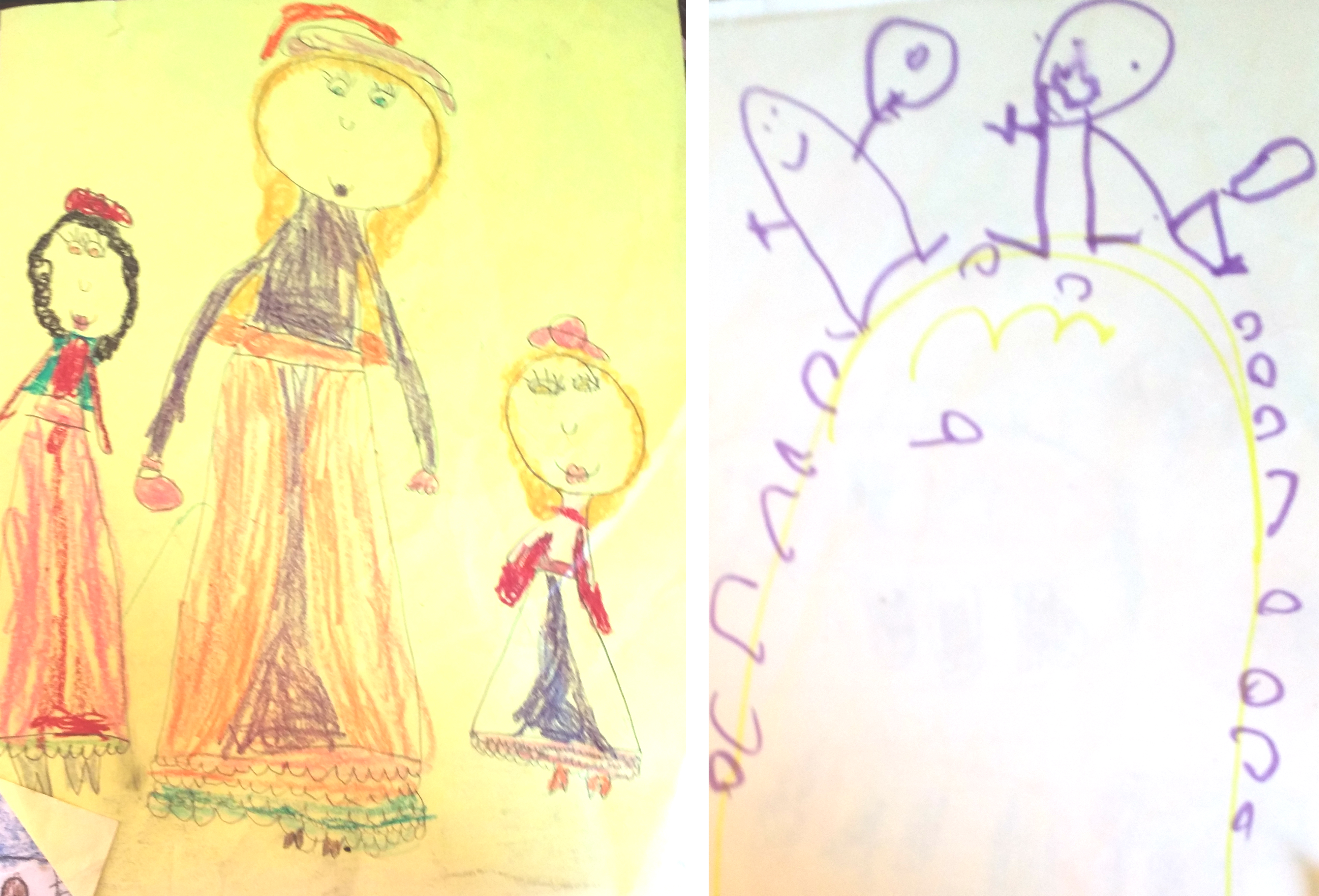
When I was about twelve years old, I began designing clothes. Before that, I drew aliens in beauty pageants, and before that, I drew women in hats. Before that, I drew potato people on hills. I also remember doing a portrait of my dad and desperately trying to remember if his mustache was above or below his nose.
Women in Hats & Potato People
Dolls & Dress-Up
I am not quite sure why I started designing clothes. We had a picture book about the history of dress. They had everything from early Mesopotamia to the Roaring Twenties. I would spend hours flipping through the drawings. I was fascinated by how sheer the Egyptian dresses were and in awe of the bare-breasted Minoan women.
My mom had taught me a basic stitch and I began making Barbie clothes, first for my dolls, then for my sisters’ when I got older. One year, for her birthday, I made a Barbie wardrobe for my younger sister, Jane, out of an old cereal box along with about ten dresses. I used rags and some of my mom’s old clothes.
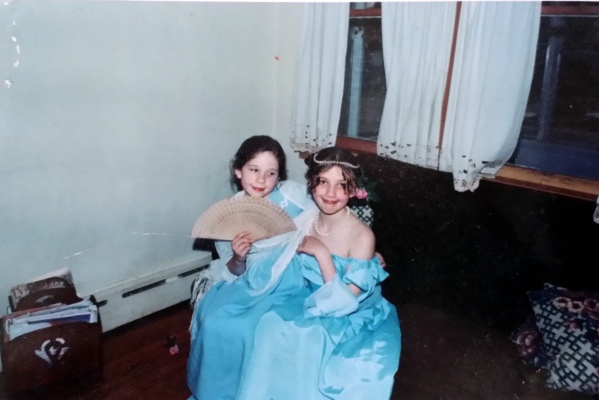
I was also just enthralled with playing dress-up. There were almost no games I played as a child that involved wearing my normal clothes. Part of preparing for a game was changing into the appropriate garments: gypsy, princess, fairy, 1940s Jew trying to escape the Nazis, Heidi. These often included second-hand prom dresses. For my tenth birthday, I had all my guests dress up. I went to Salvation Army with my mom and picked out a beautiful, blue dress made out of some kind of horrible synthetic fabric that I believed to be the height of decadence and sophistication. We ate Chicken Florentine and had a fainting contest, falling dramatically onto piles of pillows and blankets in our finery.
My tenth birthday party. Left to right: Heidi (childhood friend), me.
Whatever the reason for designing, I began. I was getting a little old to play dress-up, so my costumes came to life in drawings. My proportions were terrible: heads too big, bodies too thin. And drawing hands might as well have been my undoing.
It did not take long to decide I wanted to be a fashion designer. In my social circle, this was unique. The adults I knew didn’t design, and none of the girls I knew were interested either. It seemed to me, at the time, to be quite a unique aspiration. I now know that it is highly common for girls to go through such a phase. This miscomprehension resulted in my being territorial when it came to others with a shared interest. I remember despising a girl in my 8th grade math class when she told me she wanted to be a designer too. She had either never actually designed, or I hated her designs when I saw them; I don’t remember which.
I continued to design through high school, even attempting a few sewing projects with little guidance. It is one thing to know how to follow a pattern and quite another to try to teach someone how to bring her imagination to life. My informal instruction lacked inspiration, to say the least, and I found the speed of sewing machines stressful compared to the calming, therapeutic process of sewing by hand.
A Theology of Fashion
Despite my frustrations about apparel construction itself, I began to develop a framework of beliefs about clothing. I found plenty of opposition to my interests at my church, where women were supposed to be simultaneously beautiful at all times and never put effort into their appearance (loving Jesus makes you beautiful, not makeup). There were plenty of Bible verses that supported this aversion, not the least of which can be found in Jesus’ Sermon on the Mount: “28′So why do you worry about clothing? Consider the lilies of the field, how they grow: they neither toil nor spin; 29and yet I say to you that even Solomon in all his glory was not arrayed like one of these,” (Matthew 5:28-29).
This I took as a personal challenge, despite the admonishment against worry (and seemingly of taking an interest in clothing); I dreamed of designing something as beautiful as the lilies of the field. I even used lily of the valley for inspiration in some early designs. I figured if God created people in His image, why shouldn’t I create, too? What’s more, why shouldn’t His creation be my inspiration, even my aspiration? Where some people saw limitations, I saw liberation. My best explanation for the confusion on this subject is that some people see no difference between worry and attention, because they have learned only to pay attention to that which worries them.
I kept designing and began collecting bridal magazines. Once, while flipping through one and explaining my love of clothing to a woman from church, I pointed out a model and commented on how beautiful she was. The woman from church looked at me as though with pity. She smiled and said, “You know, you’re beautiful, too,” with just a little too much encouragement in her voice. I was annoyed that she assumed I thought I wasn’t pretty just because I thought a model in a magazine was. As it happened, I didn’t really care if I was pretty just then. I cared about the clothes being made all the more beautiful by the person who wore them. She was captivating in the flowing, white dress and blue sash. Her blonde hair and large, brown eyes displayed a kindness and a joy I rarely saw in the other photos. She looked like she could actually be a bride.
Other women from church told me what to design: more modest clothing; more functional clothing; more clothes for teens. For some reason, these church ladies all seemed to be under the impression that it was impossible to find clothes that would adequately cover their bodies and still be flattering (but not too flattering). I have never understood this. I have read so many Christian articles about how horrible fashion trends are and how impossible it is to find clothes that are appropriate for teenage girls or women. This has never been my experience, not once. I have always been able to find suitable clothing for my desired level of body coverage (I may dress boldly, but I don’t often show a lot of skin).
I would later learn that in the broader culture, many of the same objections to my interest in fashion and dress would arise, but couched in non-religious language. Women who invested in their appearance were shallow or bitchy (rather than vain). They were easy or slutty (rather than lacking in purity). But the message was the same: if you’re a woman, your body is bad, so your fascination with what covers (or fails to cover) your body is also bad.
I instinctively took issue with problematizing women’s bodies, but continued to focus on becoming a better designer.
There are some people who should not go unnoticed here, people who encouraged my love of clothing, people who saw passion as an asset and creativity as a gift. They live in a big universe, and they invited me into it. Those people have my undying gratitude and love.
University, Fashion, and Philosophy
When I took my first fashion courses in college, I was very disappointed. I had hoped for something spectacular, but found myself disliking my classmates and even some of my professors—I have rarely disliked any of my teachers; I have been less kind to my classmates. There was no spark, no setting of lofty goals, only fractions and vocabulary terms. When anyone did attempt to grapple with the abstract fundamentals of dress, they used vague vocabulary often borrowed from sociology and psychology, assigning articles written on the subject at least 80 years prior. Still, I willed myself forward, despite being unsure whether my professors even wanted me in the program or thought I had any talent whatsoever.
In the spring of my sophomore year, I took a course in logic, intending to obtain a minor in philosophy. I had enjoyed my first philosophy class so much that I decided I would enjoy another 25 credits of it.
My logic professor was a charismatic, sharply dressed enigma. He was known throughout campus for his Prada suits and bold style. He had flair, dressing better than any of my fashion professors.
He told us all on the first day of class that he loved us. I believed him.
On the third day of class, he asked me to stay after. In the hallway, away from the other students waiting to ask him questions about the homework, he told me that he had rarely had a student with my intelligence. He told me that some simple comment I had made during class picked up on a nuance that he did not think even the textbook’s author had intended. I am sure I blushed. Then, after I told him he was third professor that year to try to get me to change my major, he asked me to consider double majoring in philosophy. I don’t know that I believed his compliments, but I did start thinking about it. I couldn’t help it.
As I became more engaged in my philosophy courses, my dissatisfaction in my fashion courses became increasingly apparent. My list of complaints got longer and longer. That spark that I couldn’t find in fashion classes; it was in my philosophy classes. In fashion, my mind felt numbed, stifled. In philosophy, my mind was alive, growing. In fashion, I felt creatively, intellectually, and relationally bored. No one talked about how to design well. They reinforced the cultural stereotypes of vapidity and self-involvement. I felt that I could not relate to the other students. At the time, I thought they lacked intelligence, which may have been true for many of them, but what the program lacked—and thereby its students—was gravitas.
Added to all of this, my stylish logic professor would talk to me about design. He was intrigued by my use of color and liked to talk about predicting trends. It wasn’t fashion itself that was the problem; it seemed to be the people.
By the end of that quarter I had declared myself a double major, intent on finding a way to combine my two passions and excited to have a major that wouldn’t make guys treat me like a bimbo. There was a marked difference in people’s reaction to me when I said I was majoring in philosophy and fashion, instead of just fashion.
By the end of the next year, I had dropped fashion as a major and decided to minor in it. I could no longer pretend to be enjoying myself. I still had a couple required courses, but I was done; not done with fashion, never done with fashion. I was done with the program, the people who lived in small worlds, a professor who publicly shamed me when I came to class without makeup one day, insisting that we talk in the hall while all my classmates gawked. This was not the universe I had imagined. Lacking the influence and authority to affect any change, I needed to get out.
So I left it for costuming—taking all the tools I gleaned from fashion classes with me (which turned out to be a great deal more than I had realized). By the time I graduated, two theaters had offered me contracts for their summer musicals. I ended up designing for four shows in five months. Costuming was glorious but hard work for little pay. After four years at a private university, I could not afford that life, not with student loan repayments looming ahead. So, I set out on my own, not knowing what would come next, but applying to every reception or administrative assistant position I could find, a far cry from design or philosophy.
Elements of Design
A friend of mine recently told me that I bring fashion design into everything that I touch. She had been enjoying my cooking at a dinner party I was throwing. This is, in a sense, true. Rather, I am always designing. If it is not a dress, it is a meal. If it is not a suede tailcoat, it is a book. If it is not a summer ensemble, it is a birthday party. I love to design. Design is, in its best form, a way to do more than tell a story. It is through design that you can become the story. How grand, I have often thought, would it be to create a universe. That would be wonderful. With design, I know I am not creating matter or quarks or nebulae or star clusters. I have only this corner of a vast universe. With design, I can add a layer to reality in which my imagination becomes tangible. No, we cannot design morality or matter, but we can curate them.
This is my project, my lifelong aim. I cannot merely create a budget and a line sheet or spend hours adding, subtracting, dividing, and multiplying fractions. I will do them because they are part of the process, but they are not the goal. To design, I must always do so with the intention of presenting more than commerce. I am engaging in an idea. Either that idea contributes beauty to the world, or it does not.
This search for beauty, not merely to find it but to create it, is a lofty one. It is lofty because not enough people attempt it, and even fewer attempt it more than once.
In an age of knockoffs, failing retail, diminishing haute couture, and the near extinction of home-sewing (no, DIY pictures on Pinterest do not count), it is imperative to me to continue to strive for this lofty goal, to present the world always with something beautiful.
For a long time, we have been led to believe that for some reason beauty is shallow, especially when it comes to fashion. However, I am of the opinion that bodies are not bad and that, if anything, there are people who are shallow, and cannot properly value exterior beauty due to their own lack of interior beauty. Perhaps we have allowed their voices far too much reign on the matter.
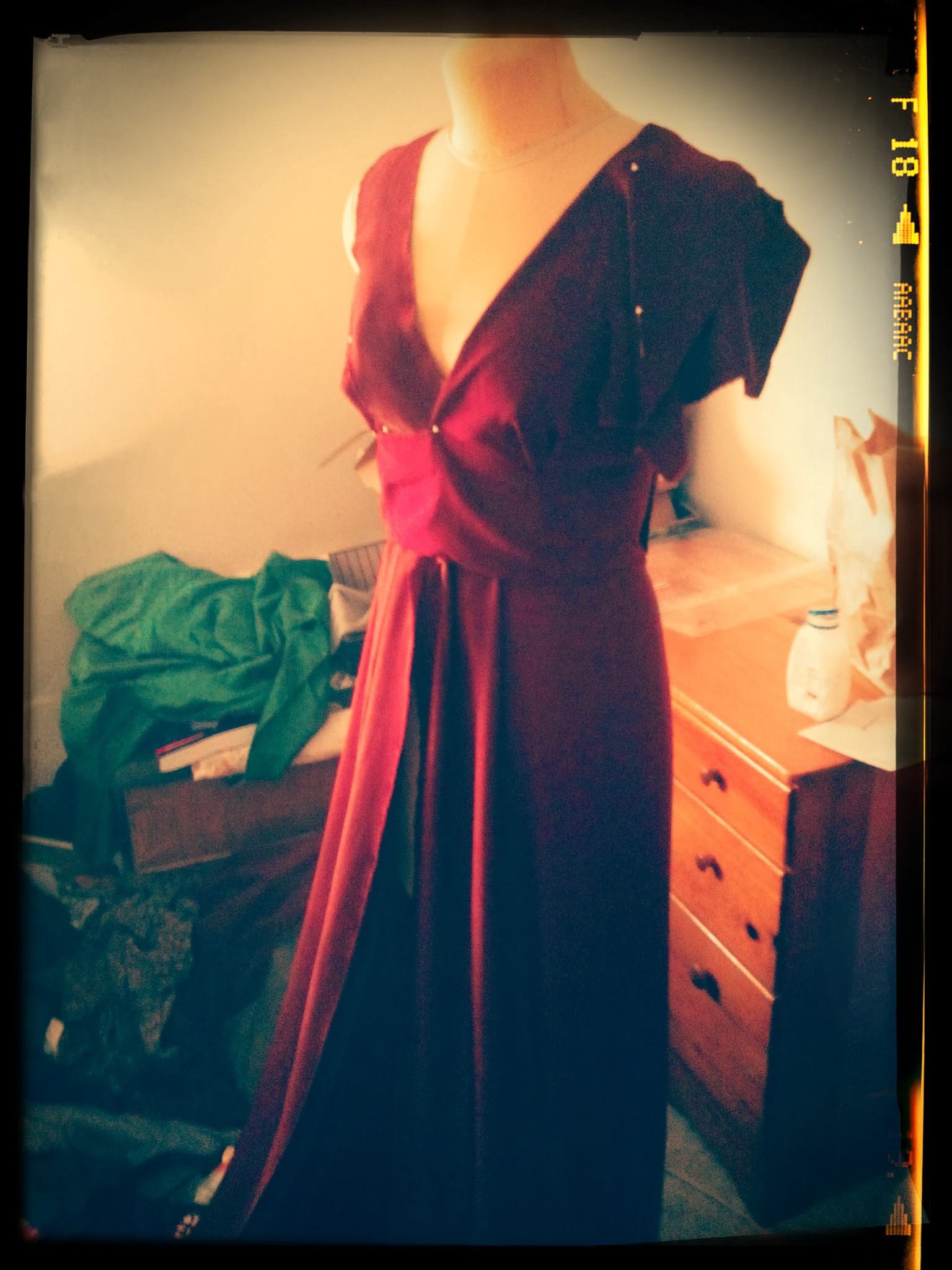
Today, I am a designer. I do not work for a clothing company. None of my designs make their way down runways or are mass-produced. In fact, most of them will never experience the incredible transformation from the page to the garment, or even reach beyond my imagination (that might be impossible in any case). However, I am a designer because right now there is a dress draped on my dress form that needs to be finished. It needs to have a chance to offer its beauty to this corner of the universe.
I have, for as long as I can remember, tried to pretend not to be poor.
You don’t have to smoke or have bad teeth or live in a trailer park to be poor. You don’t have to say “ain’t” instead of “isn’t” or “seen” instead of “saw”. You also don’t have to be homeless or car-less or live in government housing. You don’t have look like you don’t have it together. It just takes some unexpected medical bills, a car accident, or an attempt at starting a business which flops. American poverty has a lot of different faces. This one is mine.
_____________________
I don’t know when I first noticed that my family was poor. I must have been quite young, not older than four or five. I remember sitting at the top of the basement stairs when I was supposed to be in bed, listening to my parents’ argument about finances. They weren’t yelling or even loud, but they might as well have been. I remember empty kitchen cupboards, perfect for playing hide-and-seek. I remember food that didn’t come from a grocery store. I remember hating powdered milk and the kind of canned vegetables that I’m pretty sure no one has ever liked. Does anyone actually eat creamed corn?
When I was a kid, getting brand new clothing was an event. Most of what I wore were hand-me-downs from my sister or my mom’s friends with older children. Otherwise, it was from thrift stores. Target and Kohl’s seemed high-end. I will not pretend that I wasn’t delighted when I’d open up an entire trash bag full of clothes my size. I didn’t care if someone else had worn them before; the sheer volume of clothing was exhilarating. Despite this, I had learned that clothes played a significant role in how people perceived me.
We pick up on this from a young age. Boys want to wear the right sports jersey or tennis shoes. Girls need the latest hair accessories or brand of jeans. It is astounding how much of our identity is expressed and adopted through the clothes we wear.
It didn’t take long for me to develop both a contempt for youth fashion norms and an advanced sense of style, especially once I was old enough to work a summer job and could pay for my own clothes. Even before this, when I still thought I wanted to wear band t-shirts, flared jeans, and Vans, I had begun trying to conceal that I was poor. I discovered that people around me didn’t quite get what I meant when I said my parents couldn’t afford something.
One incident still stands out to me. I was spending the day with a friend from church. She had instructed me not to eat too much of whatever we were snacking on, because her parents were poor, and they needed to save money. I was a little confused, because we had gotten the snack from a pantry packed with food in the brand new house that her parents had just built. That just didn’t really seem like being poor to me. She explained that they were poor because they had just built the house. I couldn’t articulate at the time what was wrong with her comparing her parents’ financial situation to mine, but it just didn’t quite add up to me.
My house growing up, while owned by my parents, was in a constant state of disrepair. The bathroom was unfinished for many years; the kitchen had no flooring; the front steps were crumbling; we had remodeled the upstairs, replacing the breaking vegetable board with dry wall, but had never quite finished. We had only three bedrooms for our eight-person family.
Looking back, I understand why my mom would have melt-downs and go on cleaning rampages. Having a clean house was the best she could do when she couldn’t afford to fix the water-damaged ceiling or buy us new bed linens.
After my experience with my friend complaining about being poor in a completely failed attempt at being relatable, I decided to talk about it as little as possible. There was a long list of things my peers at school had that I knew I couldn’t have. This was especially apparent in my honors classes, where my classmates usually came from small, middle class families, who had lived in the city for generations.
Knowing the power of clothing, I invested in my wardrobe. I got cute shoes, fancy shirts and skirts. I dressed with sophistication. It wouldn’t be enough to fit in. Fitting in was for boring people. I had to out-dress those around me. Of course, I was an awkward teenager, so I think the closest I came to real sophistication was getting a black, velvet dress from Macy’s and wearing it to my winter formal. Otherwise, I was probably just mostly awkward.
Instead of being a normal senior in high school, I went to France. This might seem alarming given the picture I’ve painted of my childhood. But you won’t be surprised that I did extensive research and found the cheapest program so I could spend my year abroad. I don’t know how or why my parents contributed as much as they did, but I got there. It was one of the most difficult things I have done, and the reward was well worth it. I got to sit in coffee shops and sip Espresso, see Paris twice, Spain twice. I made friends and flirted with a boy name Valentin while he played the piano. I ate incredible food, learned how to cook some of it too. I learned about fashion, and got way ahead of the game, wearing skinny jeans and scarves well before they caught on in the States. I fell in love with one of my host families, and still get homesick for them. I did almost all of this for free. Despite my 70 EURO per month allowance, my life was so very, very rich.
I returned from France with an even more advanced sense of style and an acceptance letter to the college of my choice. I had become so very good at pretending not to be poor that I decided to go to a private college. Anything that I didn’t get covered with grants and scholarships, I paid for with student loans. Every year there was a shortage in my financial aid package, and I had to do battle with them to find out how to make up the difference, which really just resulted in more loans. This was embarrassing, and there were many tearful phone calls to my parents.
One nice thing about college is that almost everyone is kind of poor, so most of my experience felt like it had more of an equalizing element. However, one evening, during a conversation with a group of students over tea and toast, the subject turned to class and education. They were speculating on the likelihood of the poor being able to succeed in education, given the typical differences in social norms. I remember feeling as though they were missing something important. They were right that a lot of people who grow up in a certain income bracket would probably have a more difficult time getting to and succeeding in college. Their parents are more likely not to value education in the first place, so that as young as kindergarten, they are already behind their peers. This gap increases over time, making college a non-option even before anyone ever suggests it. However, they were missing another option: people who were raised by educated people, but were still poor. I tried to describe the nuances of pretending to be a member of the middle class. I failed. The group didn’t understand how I could be sitting there in my nice clothes being poor. I was playing the part too well.
This is still an issue today. When I wasn’t working, and I was homeless at the end of last year, I stressed about finding a midpoint between struggling-to-get-by and responsible-adult-who-isn’t-just-looking-for-handouts when I signed up for food assistance. Meanwhile, I am well versed in bourgeois conversation. What’s more is I have a degree and can talk circles around most people. How could anybody guess that in the two years since graduating college, my average income has been about $14,000?
I don’t know why it matters that I try to pretend not to be poor. I try to eat organic and free-range foods. I talk about culture. I attended college. I get good haircuts. I even get massages sometimes. I go out to restaurants with my friends and offer to pay for coffee. Sometimes, I buy the good butter instead of the cheap stuff. Maybe I shouldn’t do these things. Maybe I should face my poverty, and tell my friends that all they get is a card for their birthday, as long as I can afford that. Maybe it’ll just be a letter written on some borrowed printer paper. Maybe I should live that way. Why do I pretend not to be poor? I think it’s because I want to connect to people; I want to be seen and heard. I want to have something to offer and not be constantly taking.
Once, in college, I was really running low on cash, and a bunch of my friends got together at my apartment. I hadn’t seen most of them in quite awhile, and we didn’t really have anywhere to hang out, unless I opened up my living room. I made all the food I had left because they were hungry, with no idea how I was going to get more food. What I offered my guests was supposed to last me another week. We still had a ton of fun. We laughed and talked, and people complimented my cooking. Fortunately, the next day, I got an e-mail informing me of extra grant money that hadn’t been included previously in my financial aid package, and I got the funds I needed to make rent and buy groceries for the rest of the quarter within the next couple days.
I don’t ever want to do that again. I don’t want to be so hopelessly broke and ashamed of it that I invite people over and offer them something that I absolutely cannot afford to give. However, I am so glad they came, so glad they enjoyed the food, so glad we spent time together, connecting.
Pretending not to be poor is a form of hiding. It’s fueled by shame. It’s fueled by the fear of being disconnected. Most people, when they learn about my financial situation, get really uncomfortable. They either say something completely oblivious or insensitive, or they change the subject. Pretending not to be poor is an attempt to avoid this experience, to make the world think I am a capable adult, to make myself think so as well. And in spite of this, I have learned that generosity is better than buying more razors to shave my legs. Connecting is better than having a new computer or having an expensive hobby. I can go an extra month without getting a haircut if it means I can go out to drinks one extra time with a group of people dear to me.
This is my story. I don’t want to pretend any more. Poverty is about the state of my bank account. It is not who I am. I am courageous. I am daring greatly.
 An Indomitable Grace