By ee cummings

somewhere i have never travelled,gladly beyond
any experience,your eyes have their silence:
in your most frail gesture are things which enclose me,
or which i cannot touch because they are too near

your slightest look easily will unclose me
though i have closed myself as fingers,
you open always petal by petal myself as Spring opens
(touching skilfully,mysteriously)her first rose

or if your wish be to close me, i and
my life will shut very beautifully ,suddenly,
as when the heart of this flower imagines
the snow carefully everywhere descending;

nothing which we are to perceive in this world equals
the power of your intense fragility:whose texture
compels me with the color of its countries,
rendering death and forever with each breathing

(i do not know what it is about you that closes
and opens;only something in me understands
the voice of your eyes is deeper than all roses)
nobody,not even the rain,has such small hands
An Indomitable Grace
Thoughts on mercy, humanity, vulnerability, and beauty
-
-
Because there is evil in the world,
dear one, and brothers slay brothers,
and men are cowardly, even in their words,
hiding behind rhetoric and platitudes,
and even less valiant in their actions;
let me rest in your arms tonight
and listen to the gentle rhythm
of your life, defying this creeping despair.Because fear and apprehension are wasted time,
a disservice to uncertainty, to humanity, to God,
a surrender to the tragedy,
a capitulation to the darkness;
let me stay by your side for whatever
minutes or hours or days or weeks
or months or years remain to us.
Oh darling, let me come Home.Because there is beauty in the world,
casting the light of redemption—
when good is allowed to grow,
when heads and hearts forget
their fancied or fabled fear—
even on the darkness of death;
let me rest in your arms tonight,
becoming one within and without.Because there is Love in the world,
whispering sight and sound and health,
overwhelming the grave, defeating defeat,
living every day as a gratitude,
a grace, a gift, a greatness;
let me sing, too, the susurrant hope
of the Creator and the created.
Oh darling, let me come Home. -
People talk about unrequited love like it’s some kind of tragedy, like the person who loves is the one who is deficient. And it is a tragedy. We live in this broken world where we can’t predict or control everything, where love doesn’t always get to grow at the same rate or between the same people. But you have to give yourself permission to love who you love when you love them. That doesn’t mean you should negligently let someone else hurt you, and you shouldn’t become a stalker. Boundaries are important, but it’s ok to love at a distance, and it’s ok for that love to hurt, and it’s ok that it will fade eventually, even though you don’t want it to. And it’s ok to sometimes do something a little stupid for love’s sake, not because that’s what love is or what lasting, healthy relationships are founded on, but because our best lives are ones lived in love. So it’s ok if you decide to fight for it.
-
I have a friend who will sometimes pour us what she calls “let’s be honest” glasses of wine. These are very full—very full. I have yet to determine whether she wants to be honest about how much wine we want to drink in the first place or if she thinks that if we drink more, we’ll be more honest. Maybe it’s both.
Ok, so let’s be honest.
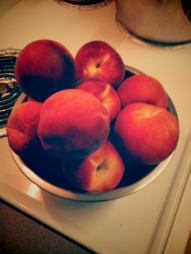 I don’t really like peaches. Sure, perfectly ripe peaches are divine, or at least point us in the right direction. Eating an under-ripe peach, I’m positive, is akin to eating squishy tree bark. Eating over-ripe ones: just don’t. I will admit there is a narrow window of acceptable peachiness. That version of peaches, I could eat until I die.
Unsurprisingly, I don’t like peach pie. What is worse than a raw peach that is outside of the acceptable ripeness window? Cooked peaches. This includes canned peaches. This includes peach cobbler. This includes all peach-flavored things. To quote an incredibly obscure song from an incredibly obscure musical I was in once, “Peaches have fuzz, and I don’t like ‘em cuz, they’re soft and squishy, kinda slimy like a fishy.” Mix that with a dry, heavy, crumbly crust, over-sweetened filling, and corn starch holding all the goo together, and you have a pretty terrible pie.
You can imagine my skepticism when my mom told me about this fantastic peach pie she had made. Even though there was no wine involved, I pressed her to be honest about why she thought this particular pie was so good.
My grandparents used to live in a house with a peach tree in the front yard. This provided a plethora of peaches in late summer, which my grandpa preferred to eat with cream. I decided to make the pie, not because I thought I would like it, but because it would give me a way to use up a lot of peaches. At the very least, my grandparents could enjoy the dessert.
I wrote down the recipe based on my mom’s instructions. I gathered ingredients. The crust called for lemon juice and butter instead of shortening, yielding the best crust I had ever come across. This was encouraging.
The filling called for mace.
I know what you’re thinking. Claire, don’t you use mace to ward off an attacker or scare away evil demons? The answer to this is yes. However, mace can scare away the demons of your soul when you eat it, by being delicious, because it’s made from the outer casing of nutmeg.
Additionally, the filling called for flour, not corn starch to keep the juices from being too oozy; it also called for an egg wash over the top crust.
The resulting pie was the best pie I have ever had.
It was gloriousness wrapped in a flaky, light crust that had been browned to perfection. The mace gives it a kick of spiciness—not too much. There wasn’t too much sugar, allowing for the best part of all: the peaches tasted like peaches. Sure, they were softer and warmer, but they still tasted like the sun-kissed glory that peachy perfection should be. It also doesn’t even need ice cream.
So now, when I make a pie, it’s a peach pie. I have made dozens by now.
I am a pie particularist, meaning I can get really picky about pie—about most dessert, really. So, when people offer me pie and I tell them I’m not really in the mood for dessert, the truth is that I am just not in the mood for that dessert—this is about honesty, after all.
I imagine there are other pie particularists out there. Maybe some of them think that peach pie can only be mediocre, inferior to the glory days of a finicky fruit. This recipe is for them. I have tweaked it slightly, but a similar recipe can also be found in The Gourmet Cookbook, edited by Ruth Reichl.
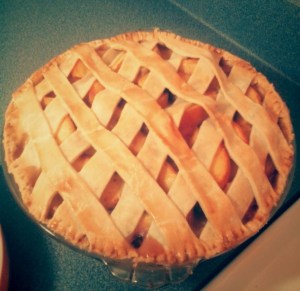
Let’s Be Honest Peach Pie
For Crust
3 cups all purpose flour
3/4 tsp salt
1 cup (2 sticks) unsalted butter
1 Tbs fresh lemon juice
1/2 cup cold waterFor Filling
3 lbs perfectly ripe peaches, pealed, pitted, and sliced
1/4 cup fresh lemon juice
3 Tbs rum
6 Tbs all purpose flour
3/4 cup brown sugar
1/4 tsp salt
pinch of mace
2 Tbs butterFor assembly
1 large egg yolk
1 Tbs waterFor Crust: in a large mixing bowl, mix flour and salt. Cut in butter with a fork or by hand until the butter is pea-sized or smaller and the mixture feels grainy. Add lemon juice and blend gently with a fork. Add cold water one Tbs at a time, blending with a fork until the crust is slightly sticky and all the mixture forms one lump of dough. Do not over-mix. For the most delicate crusts, the less friction created during the assembly, the better.
Separate the dough into to pieces and form into disks about 1.5 inches thick each. One should be slightly larger than the other (this will form the bottom crust). Wrap each in wax paper and refrigerate for 30 minutes.For Filling: in a large mixing bowl, combine peaches, lemon juice, rum, flour, brown sugar, salt, and mace. Be sure to stir very gently, tossing the peaches so they maintain their shape, being careful not to bruise them.
Preheat oven to 425°F.
For assembly: Remove crust from refrigerator. Generously flour your counter-top or pastry board. You should give yourself at least 18×18 inches. Take the larger piece of dough and roll it out, beginning from the center and pushing out. You may want to turn the crust over once or twice to ensure that it won’t stick to the counter. When you are finished, the crust should be even, less than 1/8 inches thick. Gently fold crust in half and in half again and transfer to a 10 inch pie plate. Unfold the crust and center it in the plate.
Add the peach mixture, spreading it evenly. Next, roll out the second piece of crust in the same fashion as the first. Instead of folding it, cut 1-1.5 inch wide strips and lay them across the top of the pie to form a lattice.
In a small bowl, mix large egg yolk with water. Using a pastry brush, slather the egg wash over the pie. Using a fork, press the edges of the crust together, then trim the excess crust with a knife.Place pie on center rack and bake for 20 minutes. Reduce temperature to 375°F and continue baking for 45-50 minutes. Let cool for at least 1 hour before serving.
Don’t forget to eat the entire thing right out of the plate at least once.
-
There have been times, and maybe there will be again, when fear gripped me so tightly, that I struggled to breathe. I forgot everything else. I forgot to see. I forgot how to turn on the lights to scare away shadows. Those moments have shaped and rearranged me. I am not my anxiety. I am not my depression. But I carry them with me, even on the sunniest days, in the happiest moments.
The first time I had an anxiety attack, I was thirteen. This was right after a Sunday school lesson about demons, and I found myself wondering for months, maybe even years, whether I had experienced a demonic attack. It was a scary time, a time before my nightmares had stopped, a time before I knew how to have faith without positive emotions. I thought that if my emotions could be swayed so easily, my salvation and my Christianity were false. I questioned God’s existence, and, despite continuing to attend church regularly, I felt wildly alienated from it.
It happened just before I registered for seventh grade. I would be in a new school, in with the big kids (in my school district, 7th through 12th graders shared a building). I had been dreading growing up all summer and mourning the loss of my childhood. Finding comon ground with Peter Pan, I didn’t want to grow up at all.
It was a Sunday night. I had been lethargically spending my last days of summer, being as unstructured as possible. After the talk about demons, I had an uncomfortable feeling as I got ready for bed, a tightness in my stomach, a sense of dread pawing at the back of my head, right above my neck. I decided to sleep downstairs, on the main floor, instead of in my bedroom, upstairs. This is something I did often when I was younger due to frequent nightmares; I had grown adept at predicting when I would have one and preferred to be close to my parents’ bedroom. This way I could stay up late reading without keeping my sister awake, hoping I could ward off the various villains of my dreams with a book. I would eventually fall asleep, regardless of my efforts. Then, the nightmare would come.
This particular night it was different. It was dark and warm, as Augusts in Minnesota are apt to be. I laid out sleeping bags and tried to settle in, but I couldn’t. Instead of drifting into an unconscious hell, I was wide awake. My chest got tighter and my mind raced faster until I could no longer think. Fear was all there was. I felt paralyzed. Just the same, I forced myself through the kitchen and dining room—it seemed to take an eternity—into my parents’ room. My mom was still awake, a lamp lighting the room, providing some amount of relief from the terror of darkness just outside.
My mom looked at me and asked what was wrong. I don’t remember if I managed to say anything or if my face gave away my distress. Then my mom prayed. She prayed and prayed. I threw myself on her bed and cried. Eventually, I began to breathe normally again. The gripping sensation in my chest subsided. My mind calmed and I focused on the words my mom was saying, the love and concern in her voice, the reassurance.
My mom began to sing a song that I had heard ever since I was little “Jesus has all authority here in this place, He has all authority here, for this habitation was fashioned for the Lord’s presence, all authority here.” It was immensely comforting.
For the rest of the night, and for several nights after, I slept on the floor in my parents’ bedroom. I would fall asleep holding my mom’s hand.
In the following months, I seemed to lose my identity, my sense of grounding. I didn’t trust anything I thought or felt. Seventh grade began, which was difficult enough; new classrooms, new teachers, new classmates, a whole new way of life. And while cruelty exists among children of all ages, suddenly cruelty was coupled with extreme emotions and the makings of deeply rooted insecurities. For the most part, I could handle the blonde girls with straight hair who had icy stares and snide comments. I could handle the guy from Illinois, (who I thought was kind of cute) calling me ugly “as a joke” every day. Even then, I knew these things were ultimately unimportant.
What I handled less well was the existential angst I was undergoing. I hadn’t discovered Descartes yet, so my eyes hadn’t been opened to the ultimate good that comes out of doubting everything; and I really, really wanted to be a good Christian. I wanted God to exist. I wanted my faith to be real.
I did not know then that my depression was probably made worse because of some vague impression I had that Christians were supposed to be cheerful. I had had little to no exposure to healthy attitudes regarding depression. Mental health was a taboo and framed as a spiritual affliction, not a chemical imbalance. Even when my youth pastor resigned that year due to his wife’s depression, he skillfully skirted around the word, talking instead about stress and serotonin levels. For many evangelicals, maybe even people in general, negative emotions are associated with feelings of shame, when the reality is that negative emotions are healthy in light of negative life events. You can have negative emotions without abandoning hope, and you can forget your hope without abandoning God or the church. What’s more, you will not be abandoned because of these things.
These were things that I did not learn for years after seventh grade. They are things that I am still learning. This keeps my depression more or less at bay, and my anxiety attacks are short and relatively irrelevant. As a thirteen-year-old I used the tools I had available to me, which, while shoddy, have made a significant difference.
The first tool was logic: If God exists, God exists whether or not I believe it. Unless you are hardcore into Berkeley or some other form of idealism, this is pretty basic. I would repeat this to myself to prevent going down mental rabbit holes even Alice would probably have shunned. While I didn’t realize I was being intensely philosophical, this premise became a significant step in the process of understanding the relationship between belief and ontology. That simple sentence was an existential lifeline.
So I had tackled the notion that existence was belief-independent. However, my work was far from over. I had to tackle the eerie feeling that perhaps my experience of God was completely false, and that I was really being tricked by some demon, possibly without an actual will of my own, heading down a path of complete destruction and eternal torment.
No big deal. Buffy deals with this kind of thing in her sleep, right?
I remember sitting in the bathtub one day. I was nearly through my seventh grade year, and I had stayed home from school. I was staring at the faucet sticking out of the wall. The water looked almost as if it were tinted blue-green as it lapped gently against the sides of the bathtub. My mind was turning over and over again, stuck and numbed and terrified.
Suddenly I thought of something I had heard in youth group, “God is not a God of confusion.”
For the first time in months, I felt that I could trust my senses and emotions. Sure, sometimes they jumble things up and get it wrong. They don’t always match reality, but for the most part, I can trust my experiences. However defective these tools are, they worked. They gave me enough space to breathe and enough time to sort through other big questions as time went on, without a sense that I was somehow failing all of the time.
I slowly rebuilt trust in my mind, trust in God.
Today, I don’t know how many anxiety attacks I have had. They usually erupt out of an unbearably deep sense of loneliness, at times of great uncertainty, not a fear of the demonic. Lately, they have had an affinity for grocery stores as well.
I have close friends with anxiety who have taught me a lot. Recently, I’ve learned that I have a lot of family members who have anxiety. Some are medicated; others aren’t. Some see therapists; others don’t. Still others don’t even recognize their constant sense of fear as having anything to do with mental health.
Talking about it, sharing my fears, and learning from others’ experiences have all helped me shed some light on those midnight monsters that tried to steal the last moments of my childhood. Despite all the weird and destructive instruction from that Sunday school lesson all those years ago, one things was true: beastly, dreadful monsters cannot live in the light.
-
Yes, sometimes, I have to fall out of love,
and this falling is less than thrilling,
more a slow tumble down a steep decline,
as I cry out the words that have meaning
only to two other ears,
hoping he will throw himself down after me.Then, dizzy, and scraped, and bruised a little,
I brush myself off and grin.
With a smirk and a tell-tale twinkle I say,
“That was fun; let’s go again.” -
People disagree a lot. We like to assume that when someone disagrees with us, it’s because he is stupid, ignorant, or even evil. Really, most of the time, it’s about having conflicting priorities. Why are there people who are pro-life? They value the life of the unborn and want to protect it all cost, even at the cost of certain rights for women. People who are pro-choice value the rights of women and want to protect them at all cost, even at the cost of the unborn. It is probably the case that pro-lifers and pro-choicers both value the life of the unborn. It is also probably the case that both value the rights of women. I wish there was a way to have a conversation that encouraged the protection of both, but, instead, we assume that people who disagree with us are stupid, ignorant, or evil.
I majored in philosophy. I am pretty good at it. One of my first philosophy professors recruited me into the major because he thought so too. There are people who are a lot better at it than I am. There are people who are worse at it. Mostly, though, there are people I disagree with.
One thing you end up getting really comfortable with as an undergraduate student in philosophy is being wrong. You change your mind about the existence of souls or God or universals three or four times. You think that Cartesian Dualism makes no sense, even though, fifteen minutes ago, it was the only theory you knew existed. You take metaphysics and become a compatibilist just to cover all your bases. You learn that the most famous philosophers can also be the most wrong; they’re famous because they redefined the box, not because they were right.
None of us is perfect. None of us is right all of the time. We don’t have to agree about what contributes most to human flourishing, but being open to being wrong is so very important. It is extremely likely that you will be wrong about some things, so listen when people tell you they think you are. Listen past their wounded pride and their offended tone. Listen past the condemnation and condescension. Listen past their tropes and their emotionally distant wall. Listen for kindness and understanding. Listen for common ground. Listen to learn.
Then, call your mom and talk about nonsense. Cuddle with your someone. Drink some cocoa. Drink some tea. Watch some fluff about hipsters in Portland or a bad nineties mystery put out by BBC. Play a video game where you get to be the hero. Put on your favorite footie pajamas (because you definitely have more than one pair). Relax. Even when you’re wrong, you’re still OK. You are still loved and accepted. You are still human and capable of good things. It isn’t about being right, and being wrong isn’t the same thing as being bad.
-
Normally, I take Fridays to reflect on things that inspire my writing or other creative endeavors, but this beautiful poem by my dad inspires my living. There are thirty years behind these words, thirty years of failures, of joys, of triumphs, of grief, of grace, of growing in love. I am often afraid I will fail, and I have already done so in pretty much every way possible, but I am so deeply encouraged to live in love because of the two wonderful people who are my parents.
Meeting Her
By Chip Burkitt
Back when I was mad at God,
I rattled around the gloomy, tattered world
Dry as an old crust and
Dangerous as a dropped pin.
I ate alone
I slept alone
I stole brief pleasures alone.
Strange, unnamed animals came to me,
And I named them all alone.

I kept waiting for Him to slip up again
Or maybe I was expecting to catch it
For accusing Him
  (Though, really, it was all His fault.
  Who does He think He is?
  I was perfectly willing to forgive Him
  If He would just admit it
  And say He was sorry.)

I slept and had unnatural dreams.
I dreamed of a dark chasm into which one could fall and never
reach bottom forever and ever, world without end, amen.

She came when I awoke, a little stiff on one side.
In her hair were sunlight and laughter.
Her merriment unfurrowed my brow.
I desired her pixie ears, her strong chin, her lithe limbs, her
   supple skin
I desired her infectious joy.
I desired her.

We fell into step.
The day got brighter.
The road got straighter.
The air got lighter,
   And I gingerly began to trust Him again.
-
Once in awhile, Seattle reminds me that it isn’t merely a cultured, educated, progressive place with good coffee and microbreweries. Instead, I am confronted with the harshness of someone else’s reality, someone else’s hysteria, someone else’s pain. She is scared, scared enough of home to brave the streets and abandoned buildings this city has to offer, scared of the men intruding on her illusory haven. She is even scared of herself.
And that’s where I see her, in her desperate state, squad cars arriving as a clean-cut young man stands just outside the foray, vainly trying to get a signal. Her face is bloody, and there are stalky, less clean men corralling her. One of them is yelling for the police.
She is standing now. No one is pinning her down, like before. Someone, not a man, is comforting her.
I leave as soon as the officer steps onto the scene. I was only there for a minute, after all. Best not to get needlessly involved. She will be taken to a place where men don’t sit on girls. She will be safe now, I hope.
 An Indomitable Grace