An Indomitable Grace

Thoughts on mercy, humanity, vulnerability, and beauty

  • My Chili

    This isn’t a food blog.

    BUT…

    I think people get chili wrong often, and I think my chili is above average, and I’m going to share the secrets I learned from my mother that make it so good.

    First some facts: if you’re from Texas, you will want to refer to this recipe as bean stew. I am not from Texas, so, to me, chili is any soup that is bean and tomato based and seasoned with chili powder. The meat is totally negotiable, which I fully understand is sacrilege to the Texans in my life. This particular recipe is vegetarian (vegan if you wish), but the secret ingredients are applicable to meat chili as well.

    Second, some opinions: soups and stews are not exact sciences. It is ok to approximate, make substitutions, etc. I like following a recipe when I don’t know what I’m doing or for a technically challenging dish, but soups are usually easy for me to get a handle on, and I can manage proportions from memory and feel. This intuitive approach comes from cooking for most of my life and following a lot of recipes first. What I’m saying is, my approach to cooking is not for beginners, because I’m not breaking down the basics. If you basically know how to make chili already, do that and add my secret ingredients. I think you’ll like it better. As general soup wisdom goes, the longer it cooks, the better it tastes (with rare exception), and alcohol makes everything taste better. Wine, beer, vodka, rum, brandy. Take your pick.

    Ok, if you aren’t just rolling your eyes about this interminable description and scrolling through to the recipe, here’s the deepest secret that nobody knows. Here is the root of the root and the bud of the bud of the tree called life–well, at least, here’s the secret my mother taught me: use mustard, brown sugar, and chocolate (not enough chocolate for it to be considered mole–I’ve done that and I’m over it now). They all cut the acidity of the tomatoes and add layers to the flavor. The chocolate also deepens the color and creates a more stew-like texture. Plus, mustard and chocolate are binding agents, so your fat won’t separate.

    Ah, at last. The recipe. What you came here for. What you skipped the description for.

    Claire’s Chili

    2 Tbs olive oil
    1 medium-large onion, finely chopped
    1 1/2 C (2-3) carrots, finely chopped
    1-3 jalapenos, finely chopped (this directly impacts how spicy your chili is, so know your audience)
    5 cloves garlic, minced
    2-3 Tbs cumin
    3-4 Tbs chili powder
    salt and pepper to taste (beans are like black holes for salt, in my experience, and I always use more than I think I ought to)
    1 cup barley
    1 large can San Marzano tomatoes
    2 – 15 oz cans kidney beans
    2 – 15 oz cans black beans
    1 1/2 cup vegetable stock
    1-2 Tbs Dijon mustard
    1-2 Tbs powdered or baking chocolate (I literally put a fancy truffle in my last pot, because it was the only chocolate I had on hand)
    3 Tbs brown sugar
    2 shots of tequila

    (Top with grated cheese, sour cream, cilantro)

    1. Heat olive oil in large pot at medium high heat. Add onion, carrot, jalapeno, and garlic. Saute.
    2. Add cumin and chili powder, salt and pepper to taste.
    3. Combine remaining ingredients. Break up tomatoes with a spatula. Bring to a boil while stirring regularly. Reduce heat and simmer for an hour or until the barley is fully cooked (a tender but still springy texture). The longer you cook it, the better it will taste, so keep simmering as time allows, and add more water or stock if needed.
    4. Serve with cheese, sour cream, and cilantro as desired.
    5. (you can do all of this in an instant pot as well, and set to pressure cook for 30 minutes. I have yet to do this so it doesn’t shut off because its thinks it’s burning, but you should try it and see. Maybe an extra cup or two of stock would help).
    6. (If you want to use meat, simply add your pound or so of preferred meat after the veggies and before the spices. You’ll want to brown it for texture and flavor. You can skip the barley too).
    7. Serves a goodly number of people, like probably 6-9.
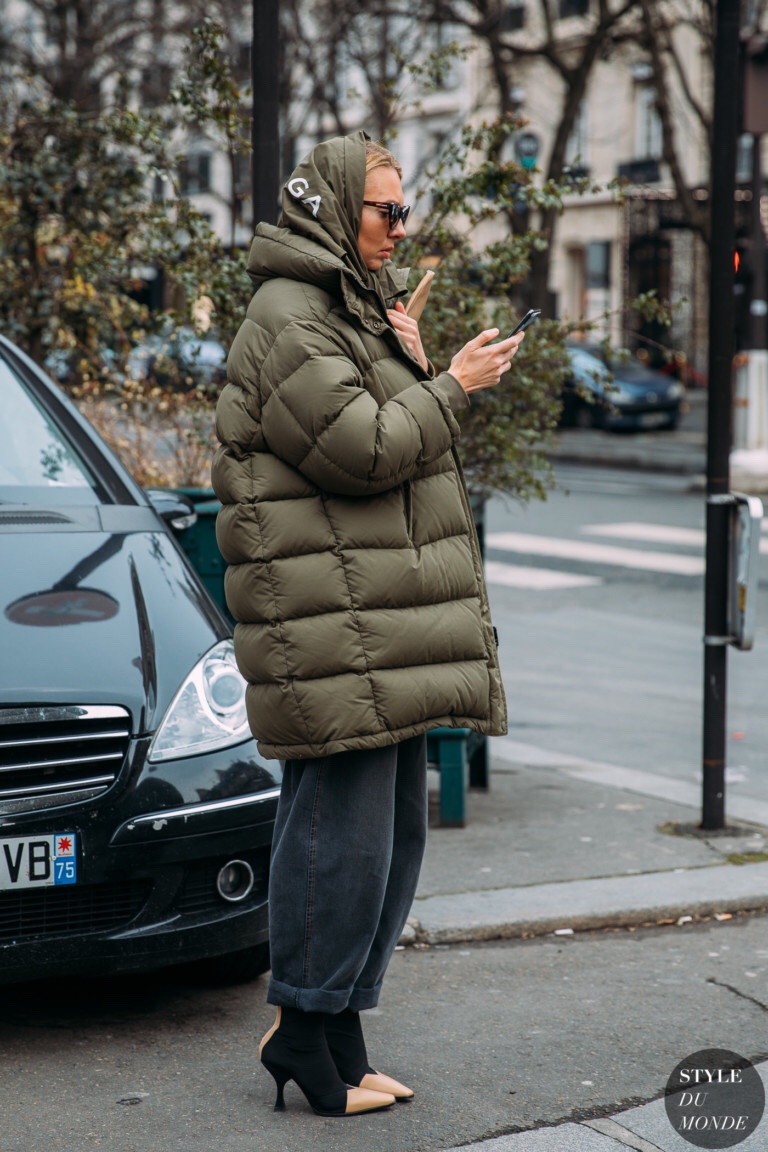
  • This outfit makes me irrationally angry. I also love it, which is why I’m irrationally angry.

    First things first: I hate almost all the components of this outfit. I think puffy coats are the worst–yes, they are warm, but they look and sound terrible. Second, I hate slouchy jeans. I would never buy the shoes or the scarf–both of which I would categorize as fine.

    But this is a great outfit. Roberta Benteler looks fantastic, effortless and yet intentional. She’s probably achieving the golden ratio between the length of her coat and the way the she’s rolled up her pants to expose the slenderness in her boot’s ankle. This look is working.

    I guess that’s at the heart of what sometimes gets to me as a designer and enthusiast. It’s one thing if a look doesn’t work because of failed design elements or ill-fitted garments (I’m looking at you Zac Posen). That’s just human error, and now we have to suffer it walking down a runway or on a famous person. But this–Roberta Benteler–is a different thing. The whole outfit is greater than the sum of its parts. So now, it’s not human error, it’s the universe’s error that clothes I could never bring myself to buy, appreciate, or want, based on their aesthetic appeal manage to look so good.

  • Finding that perfect name for your baby takes some effort. You take into consideration family names, fictional characters you’ve loved since childhood, even geography, religion, whichever names your friends haven’t used yet. And of course you have to consider what sounds good and expresses the unique relationship that created your bundle of joy. You are unique and so is your baby. You remember the days of too many Samanthas, Katies, and Jessicas in every class, when every 6th boy was named Josh, and you know we must forsake such practices so that your child knows from day one who they are.

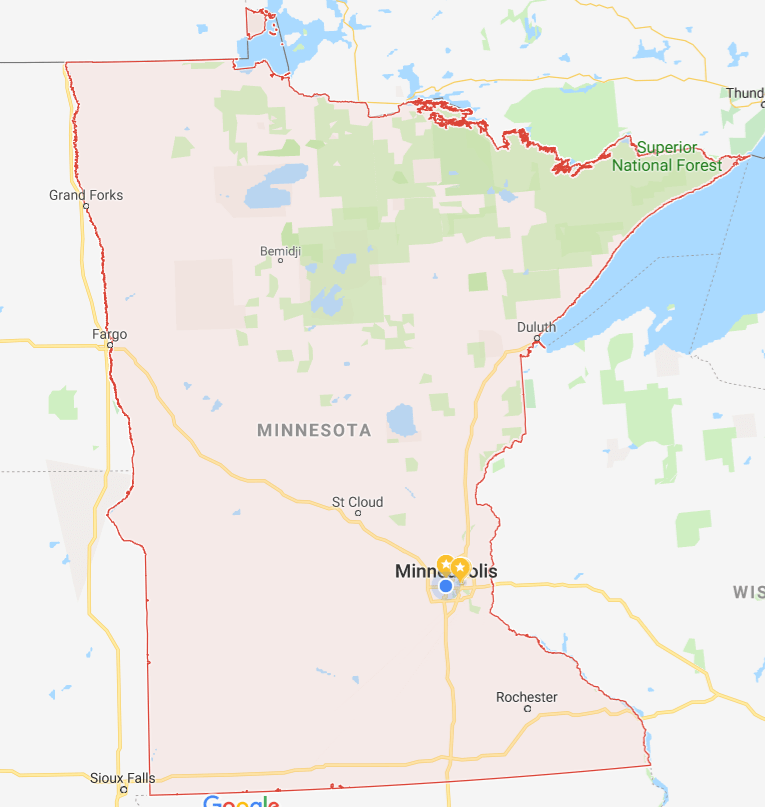
    Well, Minnesota has a solution for you. I give you the top Hipster Baby Names that are Also Cities in Minnesota, ranked:

    1. Chaska
      She wants none of your shit today. She knows exactly who she is and what she wants, and she’s not afraid to tell you that carrots are gross and mommy looks tired.
    2. Edina
      Sweetness incarnate. Everyone she ever meets will ask her where she’s from, and most won’t believe the answer.
    3. Anoka
      Anoka knows how to get woke-a.
    4. Afton
      Sweet summer child, wind, and wisp, Afton is a poet, a sensitive soul, who probably won’t publish anything but will spend their free time at local poetry workshops working on purple prose. Afton will use words like “stentorious” and “arbitrarily” incorrectly at the age of six.
    5. Eagan
      This baby is definitely wearing a bespoke onesie by six months.
    6. Blaine
      It’s almost Blake and almost Blaire but it isn’t quite either. Rest assured, your child will constantly smell like vanilla and the tears of the innocent.
    7. Duluth
      Boy or Girl, Duluth will love jumping in a pile of leaves in the fall and reading books on economic theory by flashlight in the closet.
    8. Albert Lea
      It’s almost a normal name, but those three extra letters are a real curveball, as will be your little slugger.
    9. Eveleth
      Not your grandma’s first name. But it could be, and that’s the point.
    10. Minneapolis
      Minne, for short, will have an ongoing complex about being named after a major city, but somebody’s got to break the ice. This complex will eventually lead to them going by their middle name or embracing Wicca.
    11. Hinkley
      Hinkley will always have a sophisticated rustic charm, leading to the establishment of the American version of a British, dying aristocracy. Hinkley will skip the glory days and go straight to defending the antiquated ways of wealthy country folk who have been on the land for generations.
    12. Hastings
      Typically a family name, young Hastings Phillips will often confuse his teachers as they attempt to call him Phil Hastings. Nonetheless, his name will always have a nice ring to it, dignified, said quickly, but never rushed.
    13. Hibbing
      Hibbing was born a child of the earth, and never gets over wearing overalls.
    14. Owatonna
      On second thought, Owatonna was an actual Sioux princess, so don’t name your child after her unless you are really, verifiably Sioux or someone who is Sioux has naming rights to your first born.
    15. Minnetonka
      Minnetonka means “great water,” so expect to change more than the usual number of diapers.

    Honorable mentions that are a) actually people names or b) should be people names:

    1. Winona
    2. Bethel
    3. Mora
    4. Bemidji
    5. Cloquet
    6. Chanhassen
    7. Isanti
    8. Saint Paul (pronounced: sin pl)
    9. Zumbrota
    10. Welch (pronounce with a hard ch)
    11. Hopkins
    12. Mankato
    13. Mazeppa
    14. Eyota
    15. Walbo/Dalbo

    Names that will make you child sound like a member of the British Aristocracy, but ironically. Every one of these kids has a pair of suspenders and no fewer than 4 tweed jackets by 12 months. You, as their parents, are obligated to end or begin your sentences with “my dear boy” when speaking to them, regardless of gender:

    1. Rochester
    2. Lanesboro
    3. Ostrander
    4. Brainerd
    5. Bloomington
    6. Woodbury
    7. Hazelton
    8. Winsted
    9. Blakeley
    10. Vermillion
    11. Lewiston
    12. Rushford
    13. Andover
    14. Brunswick
    15. Monticello


    Next week: A list of hipster baby names that are also lakes in Minnesota.

  • Eat The Rich

    I’ve been saying this a lot lately and kind of hoping someone will get bothered or curious about it, but no one has, so I am going to gratuitously explain why I think it’s important that we all make “eat the rich” our own mantra.

    First of all, why eat the rich? They don’t taste very good. They are usually past their prime and pumped full of preservatives and chemicals. Plus there’s the tangential concern that cannibalism is frowned upon in our society.

    Being rich is immoral. I was convinced of this by A.Q. Smith’s article “It’s Basically Just Immoral to be Rich.” Many utilitarians have made similar arguments, most notably Paul Singer, a philosopher who promotes philanthropic giving to the extreme. Other supporters include Jesus, several Old Testament prophets, and quite a few theologians since then. The long and short of Smith’s argument is that it doesn’t matter how you got rich, the extreme amount of suffering and struggle caused by poverty gives rise to an ethical burden on the wealthy not to keep their wealth.

    While this isn’t an unpopular opinion in the history of ethics, it’s an unpopular practice, especially under capitalism.

    If you find yourself wealthy, give your money away, like most of it, anything more than, say, $70,000 per year. If merely gifting makes you uncomfortable, create jobs. Pay your employees better.

    This last bit is a concession to resistant capitalists. Giving people cash is a pretty sure way they will get their needs met, but cash assistance is unpopular because we view poverty, not wealth, as morally reprehensible.

    Let’s refocus though, because we were talking about eating rich people, not convincing them with moral philosophy to change their ways. There’s a carnal difference.

    I want wealth to be suspect. I want the accrual of large sums of money to be so repulsive in our culture that rich people are afraid to be rich. I want them to be performatively philanthropic, because to be wealthy is worse than cannibalism.  

    (If you are feeling defensive right now, it’s either because you are rich, or you wish you were rich, and you should feel ashamed of yourself and your perversion).

    So eat the rich. While you may want to dismiss such a directive as hyperbolic, it is meant to erode our collective agreement that being rich is a moral good. It is not.

    Eat Jeff Bezos. Eat Brett Kavanaugh. Eat Elon Musk.

    Then, make policy changes. Make it easy to get food stamps, cash assistance, and housing assistance. Make it hard to be wealthy. Because our spending on social programs is peanuts compared to the massive amounts of capital accumulated by the wealthiest people in the world, wealth accrued while evading taxes, wealth accrued while employees subsist on government assistance, despite working full time, wealth accrued while benefiting from a system that supports white, straight, cis, able-bodied men, and actively excludes everyone else. Stop worrying that someone who gets a few thousand dollars per year in government benefits is gaming the system, and start worrying how someone making millions of dollars in a year is evading taxes. Impose steep inheritance taxes.

    Our culture is so biased toward protecting wealth, that we are still just fighting for a living minimum wage, but there has been no discussion around a wage ratio. This would create a dependency between the lowest paid workers and highest paid workers. If a CEO wants to make a lot of money, their employees also need to make a lot of money.

    I do want to make policy changes, but until then (and maybe even after), I will do my best to be performatively repulsed by the rich. I won’t keep my distrust private. If you’re rich, I think you are bad and deserve public censure until you prove otherwise.

    Eat the rich. They are the leeches of our society.

    Eat the rich. They are bad at sharing.

    Eat the rich. They break laws and use their money to cover it up.

    Eat the rich. They don’t put their money back into the economy, but you do.

    Eat the rich. They live in gated communities.

    Eat the rich. They voted for Trump.

    Eat the rich. They are liars and thieves.  

    Eat the rich. Eat the rich. Eat the rich.

  • Man Interrupts Woman at Party

    One of the things I have dealt with since childhood is men talking over me. It doesn’t matter if I am at a party or in a meeting or in school. I will be talking and a man will talk over me. This was a prominent feature of growing up evangelical. While I was at times amusing to men who found my passion and conviction unthreatening due to my youth, overwhelmingly, men paternalistically explained things to me. There are men with whom I had meaningful conversations, who invested their time and resources in me as a person. They typically were not the ones talking over me; although they did, at times, explain things to me.

    One of the reasons I have distanced myself from identifying as evangelical is because of this tendency at church and the Christian university I attended. It was always annoying, and as I learned more about feminism and equality, it became infuriating.

    I have managed to build a life where this rarely happens to me now. Part of that is because of my partner who is remarkably good at giving space to women, which in turn promotes other men in our social circle to do the same.

    I recently went to a party without him, though. I was having a conversation with one of the partygoers that ended up being broadened to the whole group, where I explain my position about why I think baby boomers are The Worst. It is an unpopular opinion in media today, but a correct one nonetheless.

    Two things of note happened.

    One, a man interrupted me with an even more unpopular opinion that was both off topic and off base.

    Two, the rest of the men in the room wanted nothing to do with it. They repeatedly attempted to give me the floor and enact other mild social shaming approaches to no avail. The first man continued to insist on talking.

    This resulted in all of us leaving the room.

    I was with active progressives at this party—they are both politically engaged and intersectionally knowledgeable—including the man who couldn’t stop interrupting me. The dominant feeling was that women with valid points should guide the conversation, not the man with an invalid point. Still the other men were unable to successful subdue the interrupting man and proceed to engage on the original topic.

    This reminded me that extricating myself from evangelicalism has not solved this issue for me or for society as a whole. The striking difference was that rather than no men helping me be heard, I had most men helping me be heard. Just the same, the outcome was that of a derailed conversation where no one felt heard, including the interrupting man.

  • When I was Homeless in Seattle

    In 2013, I was homeless.

    It was 5 months, August through December.

    I was lucky, because I never had to sleep outside.

    I put all my things in storage, and I slept on some friends’ couch or my then-boyfriend’s couch.

    I had a small selection of clothes and I went everywhere with my laptop (borrowed from a friend who had an extra one).

    I was working, but couldn’t afford a place by myself. Honestly, I still can’t.

    The uncertainty, the stress of applying for food assistance, the strain on my friends’ lives who helped me, the daily anxiety, it was awful. Thinking back on it, I can’t imagine what I was thinking starting a relationship while I was in that situation. I didn’t tell my boyfriend I was on food assistance, but he knew I was homeless—even half joked once about how I was dating him for his money. All of this reminds me of how classist this particular boyfriend was and all the reasons why it’s really good things didn’t work out.

    During this time, I also read an article on poverty by Linda Tirado, author of Hand to Mouth. If you haven’t read either, I encourage you to do so.

    My parents kept telling me to move back to Minnesota. My therapist and I agreed that I should keep trying as long as I was working. Moving back would have meant giving up at the time.

    I almost moved to the eastside to rent a room from a friend of a friend. She wanted $500 per month (which today sounds like a dream). I was making about $1500 per month after taxes and I wanted to save up for a deposit on an actual apartment. I couldn’t afford a third of my monthly income for temporary housing. I could only afford $300 per month. She didn’t seem to understand and kept offering the room at $500, like I could somehow just be flexible. Also, I was off food assistance now, because if I worked a full 40 hours per week, my gross earnings put me $20 over the cutoff. So, I had to pay for food, a bus pass, my cell phone (still a dumb phone), my storage unit, student loan payments, and still have enough money in three months to put a deposit down on an apartment—three months was the length of my contract for the job I was working at the time.

    Then help arrived: my cousin was moving from California to Seattle. His parents were financing him until he got on his feet, and they offered to rent a 2-bedroom apartment so that I could stop being homeless.

    They covered most of my rent and utilities for 2 years. I floated my cousin $300 for rent when I was working (which was only sometimes).

    By the time I moved out, I had a full-time job with benefits. While I still can’t afford Seattle rents, I can afford to live here with a roommate. But it took 2 years and a lot of money from my aunt and uncle. I lived somewhere nice with in-unit washer and dryer. I basically won the lottery.

    It’s important to understand some things when you are talking about helping homeless people.


    • People need what I got—2 years of housing—but sometimes, most of the time, they need it from the state, because their family doesn’t have the kind of resources my aunt and uncle do. Being able not to worry where I was sleeping changed my life. I overcame the worst of my depression and anxiety. I kept my room clean—like for the first time in my life. I bounced back from injuries caused by an accident on a bus. These are things that people in ultra-tiny houses and temporary shelter don’t have space to do—literally or metaphorically. I’m not saying we need to give every homeless person in-unit washers and dryers, but our standard for getting people off the streets needs to be better than a roof and four walls. It needs to be better than a dormitory filled with strangers. People need breathing room. They need keys and doors with locks to keep their stuff safe—even shabby stuff. And they need enough security where they aren’t constantly worried that tonight is their last night indoors. That includes people suffering from mental illness and addiction.

    Seattle, huge swaths of it, has forgotten this—and perhaps never bothered to know in the first place. They think it’s ok to dehumanize and demonize people on the streets. These are not lazy people. They are people who started out without a lot and got less and less, even as the people who started out with enough got more than they knew what to do with.

    I continue to be in favor of the employee head tax that the city council just repealed. I am in favor of a state income tax and capital gains tax. There is no imaginable reason why we should have two of the richest people in the world living in King County while we have more homeless people than New York City (a city with 11x our population).

    The way we treat our most vulnerable matters. It doesn’t matter if we protect big businesses. They have so much going for them, because they already have enough. We need to take care of the people who don’t have enough. Those people, you’ll find, will most often be people of color, neural a-typical, LGBTQIA+. They will be the people whose families have neglected them, whose generational wealth has been stymied over centuries of oppression, who don’t have affluent aunts and uncles. If we’re going to be a progressive city, we need to do this and do it right.

  • My company is moving to a new HQ in Seattle’s downtown core. Crime rates are higher as is the concentration of homelessness (not that either is nonexistent just 1.7 miles north) . This is a risk in terms of employee safety, but another risk is employees being skittish about being in an urban environment–because of pearl clutching, which could affect employee retention or adoption of the changes. You can’t do a lot to mitigate genuine safety risks when people are outside of the building–because they are a) rare, b) random/unlucky, c) in the open air.

    Nonetheless, we’ve taken security risks seriously and planned substantive security processes to reasonably address them.

    BUT what we haven’t done is account for perceived threats: AKA homeless people. A large chunk of my coworkers don’t like homeless people and don’t want to be around them. This is because they incorrectly believe their safety is threatened by the existence of homeless people. It’s a weird risk. It’s an extremely common risk.We risk a mutiny as soon as the safety police start sharing articles about crime rates in the neighborhood on our community message boards.

    How do you get your employees to treat their homeless neighbors as people? After all, we’re moving into their neighborhood. They were there first. Aren’t homeless people only a “problem” when we treat them poorly? Isn’t that why they are homeless in the first place?

    Mitigation: have a volunteer day. Wear our company t-shirts. Introduce ourselves. Hand out food or clothes or toiletries or bus passes. Do something for our neighbors. Then they’ll be people to us, and we’ll be people to them, and those safety alarmists won’t get nearly the amount of traction they would otherwise.

    Sometimes the best way to mitigate a risk is to act like a human being. Also, safety and security trainings just make people never want to leave their homes. Anything could happen and has happened, and there is no realistic way to make sure it doesn’t happen to you.

    I haven’t seen my boss’s risk log on this project, but I would be willing to bet a lot of money that at no point did he think that our employees might be a risk to our homeless neighbors.


    Edit: a previous version of this piece included specifics about the security steps my company is taking to keep employees safe. This was meant to provide a robust account of how seriously we take employee safety.  I agreed to edit those details when a former coworker took umbridge with some adjacent but unrelated interactions and reported this piece to my HR department in the hopes that I would be disciplined or fired. I agreed to pair down the security details, in the interest of security, but I was not required to edit this piece as a condition of further employment or as a form of discipline.

  • In case you haven’t heard, King County Democrats Chair, Bailey Stober, has been accused of harassment, creating a hostile work environment, and misappropriation of funds. He is currently under investigation and refuses to acquiesce to demands that he resign.

    You can read more about these accusations in The Stranger, Seattle Times, and The C is for Crank. Included in the C is for Crank article is a video posted by Stober on his personal Facebook page.

    Last night there was a King County Democrats meeting. I attended, but was not allowed in the executive session, which is always closed to the public. From what I gathered from hallway gossip, most of the two or so hours we sat outside consisted of people inside asking questions they knew the answer to in order to make a point.

    I enjoyed myself in the hallway, meeting other PCOs and learning about how things work at the county level. At some point some committee members who identified themselves as serjeants-at-arms were sent into the hallway to make sure no one was standing too close to the door, in case we were listening in. Of course, we were listening in, but we couldn’t actually make anything out and had begun chatting instead. They should have been more concerned that everyone inside the room had functioning cell phones (aka recording devices) on their persons.

    Later, one of the same serjeants-at-arms came out to tell a PCO not to leak sensitive information to the press. This was a bizarre admonishment, because the PCO wasn’t in the meeting and didn’t have sensitive information to leak. He said as much. By now it was ten at night, and we were all slumping a little. Maybe this why I was so incredulous about the rest of the evening.

    The serjeant-at-arms came out again and told the reporter that they needed to monitor interviews. The reporter did not like this and refused to be monitored. The most absurd moment in this utter circus was when the serjeant-at-arms said to a committee member (whose voting credential had fallen out of his pocket and onto the floor without him noticing) “Do you pinky-promise not to leak sensitive information to the press?” I think this serjeant-at-arms knew that what they were being as was absurd, yet there was a self-seriousness about everyone’s tone and demeanor, but none of the training or actual professionalism required to make it believable. I imagined that what was going on inside the meeting room was equally farcical and more upsetting.

    Once executive session ended, we were allowed back in the room. A few things happened that I think are important. First, confidential materials had been distributed during executive session that needed to be returned. However, rather than ensuring that they had all been returned before opening the doors to the public, they attempted to do so afterward. The acting chair announced that two copies were still missing and that if any committee member was found to be in possession of one they would be risking a charge of misconduct.

    Second, when a motion was set forth to further the investigation into Bailey’s actions, the acting chair announced that there were no rules of debate in the bylaws. That’s right. King County Dems have no established rules of debate.

    Third, the body decided they needed to form a new investigation team—the vice chairs who had done the preliminary investigation had been deemed too biased. Unfortunately, no such team existed, and they had no formal process at hand to appoint one. Rather than, say, draw names out of a hat or go through a strikethrough process, they agreed that the vice chairs could appoint two investigators, that Bailey could appoint 2 investigators, and that those four investigators would come to consensus on the fifth investigator. I don’t know of any investigation where it is considered ethical for the person under investigation to be allowed to choose any of the people conducting the investigation. The conflicts of interest seem self-evident to me, and I was disappointed that no one stood up to cry foul.

    Finally, an amendment was made to the motion which ultimately passed that called for the investigation to include discovering who leaked a confidential memo to the press. This is not a bad amendment per se. What was bad was the framing. I confess that I had to leave the room for a moment when this amendment came to the floor. Few things make me more angry than miscarriages of justice. The woman who introduced the amendment said that the worst thing about this entire conflict was the leaked confidential memo. She has been presented with everything that Bailey is accused of, sat in the same room as the victims, and decided that where the organization is most vulnerable is due to an as yet anonymous whistleblower and not the reason for the whistleblowing. Her proposed amendments was met with applause. As a sexual assault survivor, as someone who spent years being ignored on this subject, this was triggering. I left. I walked down the hall into a different room, closed the door, and for the first time since I was a child, I screamed. I breathed, and then I went back inside in time to see the amendment pass. I have never felt more helpless.

    What all of this highlights is that a lack of process is dangerous. For the sake of expediency, the body just allowed the person being investigated to appoint his own investigators. I urge Legislative Districts and other counties to put processes into place about how to investigate your chairs or other leaders in your org. The #MeToo and #TimesUp movements have shown us that abusive men in power don’t get to stay in power anymore. While it is inconvenient, even painful, for the organizations that go through public accusations, it is made more inconvenient when you don’t have a way to sort through it. It’s painful for the victims most of all who, rather than feeling heard, safe, and affirmed, are part of a drawn out faux-trial. The longer this goes on, worse it is for everyone and the more likely it is that Bailey will continue to do harm. The best thing Bailey could have done was say “I’m sorry; what can I do to make it better?” and then gone and done those things.

    Full disclosure, I think Bailey should resign immediately. He has said he wants due process, but if I learned anything last night, it’s that KC Dems don’t have one to offer, and it is partly Bailey’s fault as their chair. I fully believe the victims in this situation, but even if I didn’t, the accusations and the financial situation Bailey has put the organization in have reached critical mass. Bailey’s continued presence is a hindrance to fundraising efforts, fuel for our political opponents, and alienating to anyone who identifies as a victim of sexual harassment. Further, Bailey’s behavior since the accusations has been categorically unprofessional and childish.

    My final anecdote from last night took place at the start of the meeting. Bailey, rather than opening the meeting by announcing his resignation, brought up the treasurer to give a financial report. She did so, painting a dire picture. KC Dems would be in the hole $3,000 if they paid all their outstanding bills. That doesn’t include pending litigation that is likely to result in a yet to be determined fine. A member of the Executive committee took this opportunity to pay his dues. Bailey also took the opportunity to perform a piece of theater. He handed over a check made out for $5,000 to the treasurer. He did not say where it had come from. This was met with applause. I cringed and rolled my eyes. Great. He is the reason they are in this financial situation to begin with, and $5K hardly addresses the $163K in funds he has depleted. In this moment Bailey proved his interests lie in himself over the wellbeing of the organization, that his is a politics of theater and not of substance.

    Edit: The check for $5,000 has since been rescinded. It was the fulfillment of a 2017 pledge from Dow Constantine, according to the KCD treasurer.
  • They Wished

    They wished to say I was an intellectual,
    equipped with always a book and an idea,
    and so many uncomprehended words.

    They wished to say I was an evangelist,
    a prayer or a verse uttered often
    in places they said God doesn’t belong.

    They wished to say I was poor,
    unable to find a job, homeless,
    in an unscalable wall of debt.

    They wished to say I was dumb and easy,
    investing in my wardrobe and loving fashion,
    accepting and accentuating my curves.

    They wished to say I was an artist,
    pages of doodles and imaginings in stacks
    and paint stained hands.

    They wished to say I was a girl,
    smaller and weaker,
    with my long hair and dresses.

    They wished to say I was a writer,
    filling pages of one notebook after another,
    forgetting my purpose, getting lost in a new couplet.

    They wished to say I was a prude,
    as I championed the memory-old code,
    not letting their lips touch mine.

    They wished to say I was secure,
    unaware of my bank account,
    seeing only skin and height and composure.

    They wished to say I was a pagan,
    loving and accepting science,
    and dancing naked in the moonlight.

    They wished to say I was an academic,
    with my teaching tone and studies to prove,
    and always dreaming of the Ph.D after my name.

    They wished to say I couldn’t.
    They wished to say I should.
    They wished to be the experts.
    They wished I would be just one thing or nothing at all.

    They wished.

  • Dear SPD Officer Couet,

    We’ve never met. That’s not exactly true, but during the 10 or so minutes I stood centimeters from you on Sunday, August 13, as you propelled me backward with your bike, we never really got formally introduced. I was standing on a public sidewalk, and someone, not you, someone you take orders from, decided I was in the way. I wasn’t the only one corralled off a sidewalk we pay significant sales taxes to freely walk down. In a very technical sense, I wasn’t even part of the extremely valid, anti-fascist, anti-racist, peaceful protest. My heart was with them, but you blocked my body. Indeed, had you and your compatriots not decided I was in the way, there would be no record of my participation in Sunday’s march, no further evidence of SPD’s continued and blatant use of excessive force. But now I have bruises up and down my thighs where you pushed your bike into my body. You were wearing body armor and dark sunglasses. Your name and badge number were written on a piece of duct-tape, stuck to your chest piece. I was wearing a pair of jeans and a crop top. I wasn’t really prepared for the protest. I have been recovering from mono, so I just wanted to be a body for 30 minutes, before I got too tired. I wanted to stand in solidarity and denounce the very same Nazism you protected on Sunday, not let my illness overcome my convictions. I knew my gesture would be small—the absolute least I could do. And considering the arrests and pepper spray that others endured at SPD hands on Sunday, considering the recent murder of Charleena Lyles, my gesture was small.

    When you told us to move, I just knew, I wasn’t going to help you. I looked at my boyfriend in silence, and we both knew. We would practice non-compliance. I put my hands in my pockets and I faced you. Why did I do it? I just did it.

    You pushed me. You stepped on both my feet, causing me to momentarily lose a sandal. With each push, you yelled “Move Back,” and made sure your orders were followed. During those ten minutes, you never met my eyes. I looked, and I looked, silently, gazing. You were wearing sunglasses, but I could still catch the light off your irises, never looking me in the face. As you pushed and pushed, I thought to myself, even here, even now, you, officer Couet, are human. I will give you humanity by looking you in the eyes. Why did you never meet mine? You would not afford me the same courtesy I was affording you. Maybe you just haven’t read enough Levinas.

    I want to be absolutely clear about one thing. What you did, if you had been anyone else, would be assault.

    I said one thing while I stood across from you. A debate had begun between the officer to your right and the men to my left. The other officer tried to get out of being accused of upholding a racist system by saying that America is racist, so doesn’t that make us (the people being pushed) racist too? Of course, to him, being called racist is an insult, so he thought we’d be mad to hear him affirm the very reason we showed up in the first place. I have no delusions about how racist I am. Of course, you didn’t know that. You didn’t know that the only difference between my racism and yours is that I acknowledge and fight against mine. But you wouldn’t know that, because we’ve never really met.

    I regret breaking my silence to speak. Not because I was wrong or unsteady. But because you weren’t hearing anything that was said. What I wish I had done was sing. I have a good voice. At my birthday parties, every year, my friends push me into singing “La Vie en Rose” by Edith Piaf. I did once on a boat on South Lake Union, so now they want me to do it every year. I kill at that song. But that’s not what I wish I had sung on Sunday. I wish I had sung “Down by the Riverside.” My boyfriend and I have been practicing. I heard a version of it that I loved at a church service in college, so when we started building a repertoire of protest songs, I added that one to the mix. Maybe you’re familiar with the lyrics, “I’m gonna lay down my sword and shield, down by the riverside and study war no more.” Of course, swords are really passé, and you didn’t have a shield. You had body armor and a bike. But you get the point. It would have felt really good to sing in the middle of being afraid that the officer behind you, strutting around with his pepper spray out and unpinned, was just itching to use it. It would have felt good to make something beautiful while you were using force, violence, and threats to prevent us from peacefully observing a protest. And you see what you did right? When you pushed. We stopped being the observers and became the protesters, separated from our march.

    I want to say a few words about the people who have suffered (not just been pushed around) at the hands of SPD, those who have been pepper sprayed, unjustly arrested, murdered. Charleena Lyles, Che Taylor, John T. Williams. They are, more often than not, people of color. The people on the south side of the street on Sunday, the ones who were more vocal than me, the Black people, they knew that they were already risking so much more than me by being there. I didn’t get to hear from them whether your fellow officers pushed harder or used stronger threats. I know that I had an easier time for being white, that your final statement before you rode off on your bike so recently weaponized against me, “No hard feelings,” may not have been uttered but for the color of my skin. (Also, of course you had no hard feelings. You had all the power and all the protection. Why would you harbor hard feelings for us?). All of this is to say, I know that there are people risking more, people who stayed with the march longer, people whose trauma will outlive the tape I have on replay in my head of you pushing me backward. I know that what I do is little, that I’m opting in with my whiteness when I work toward anti-racism. I know I can leave when I get tired, go through most of the world as if it were made for me (yeah, we’ll a put pin in how you handled rape allegations against Sheriff John Urquhart, and how I can’t escape sexism). But I will keep putting my body on the line, even if it’s just to create a little breathing room between you and the people of color I’m showing up for.

    This part isn’t for you, Officer Couet, but I hope you read it anyway.

    I know I can write these things because of my whiteness. I know that the potential for white outrage is higher because of my whiteness. I hope anyone who reads this, who finds themselves angry about the idea of a white woman and her white boyfriend being pushed around by riot police infuriating, check yourself. How mad were you when you found out Charleena Lyles and her unborn child were killed? What are you doing to make it possible to prosecute a police officer in Washington state? How will you put your body on the line? Have you paid a Black woman today?

    See you around, officer Couet. Next time, I hope I have the presence of mind to sing while you assault me.

    -Claire